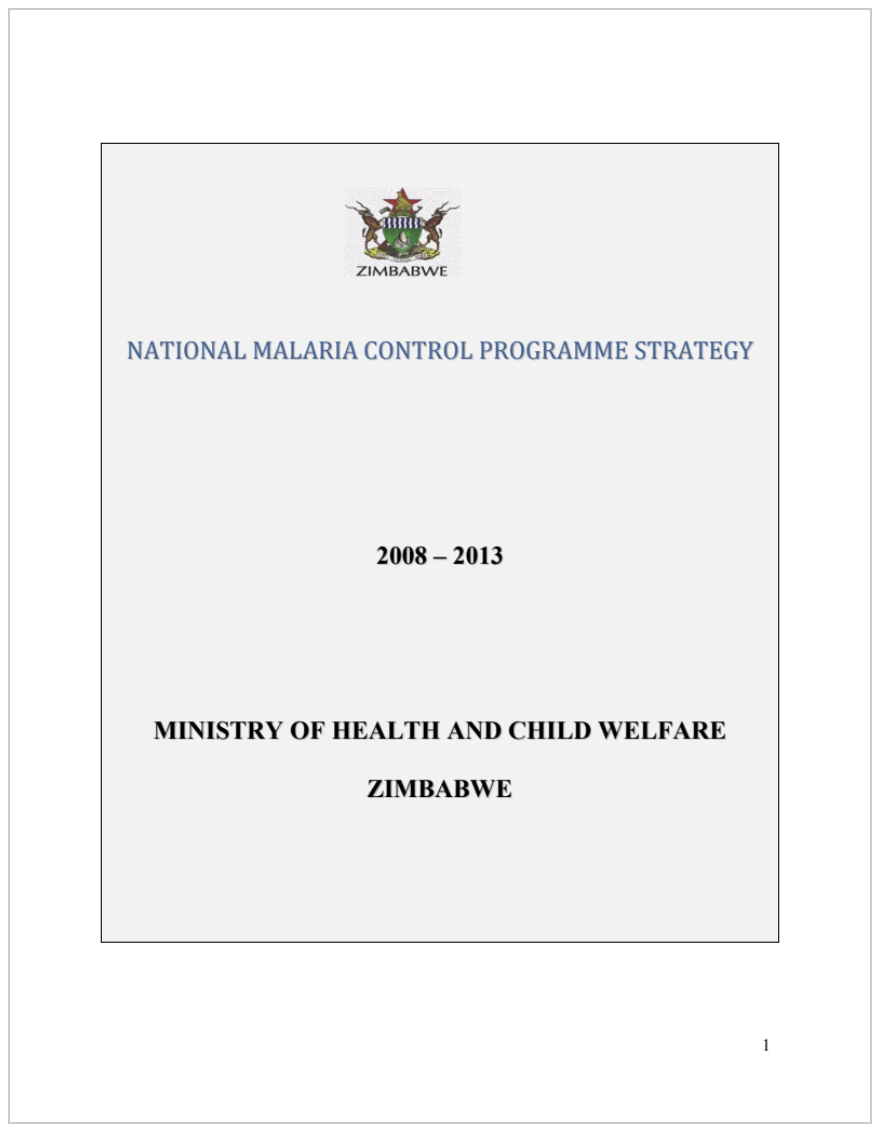
National Malaria Strategic Plan (NMSP) of Zimbabwe: 2008 – 2013
Countries: Zimbabwe
Published: 01/01/2009
The Zimbabwe National Malaria Strategic Plan 2008–2013 addresses national health and development priorities included in the National Health Strategy for Zimbabwe, the United Nations Millennium Development Goals (MDGs) and the Abuja convention declaration. The malaria control strategy contained herein includes measurable performance results including malaria-specific morbidity \and mortality targets. The strategic plan provides a monitoring and evaluation framework, ensuring that Zimbabwe deploys an evidence-based and cost-effective package of interventions that are appropriately evaluated and documented.
Vision: The vision of the Zimbabwe National Malaria Control Programme is to have a malaria free Zimbabwe.
Mission: The Mission of the National Malaria Control Programme is to have equity in health status and health care, comprehensive quality services, cost effectiveness and efficiency, providing client satisfaction, transparency and accountability, ownership and partnership as well as monitoring and evaluation of the performance of the malaria control programme.
Goal: To reduce malaria incidence from 95/1000 in 2007 to 45/1000 by 2013 and case fatality rate from 4.5% in 2007 to 2.5 % by 2013.
Strategies, Objectives and Targets:
- To achieve universal access to malaria prevention and personal protection
- To reduce the transmission of malaria by scaling up effective vector control interventions (IRS and ITNs) to 90% of the population at risk.
- To achieve at least 85% of intermittent preventive treatment (at least IPT2) in pregnant women attending antenatal care in all medium to high transmission areas of Zimbabwe.
- To improve diagnosis and treatment of uncomplicated and severe malaria.
- To provide access to appropriate malaria treatment within 24 hours of onset to 85% of all suspected malaria cases.
- To confirm and correctly treat all malaria cases.
- To improve detection and timely control of malaria epidemics
- To detect and effectively manage at least 95% of malaria epidemics within two weeks of onset.
- To increase malaria free zones in Zimbabwe.
- To strengthen community and other stakeholder participation to maximize achievement of universal access to malaria control interventions
- To increase community uptake on correct malaria prevention and control measures to 85%.
- To increase the participation of other stakeholders in malaria.
- To improve coordination, management and monitoring for achieving of universal access to malaria control interventions
- To strengthen malaria surveillance, monitoring, evaluation and operational research.
- To strengthen planning, partnership building and coordination.
- To strengthen the management of malaria control programming through adequate financial and human resource management, logistics support and procurement and supply management.
Published: 01/01/2009
Related Resources