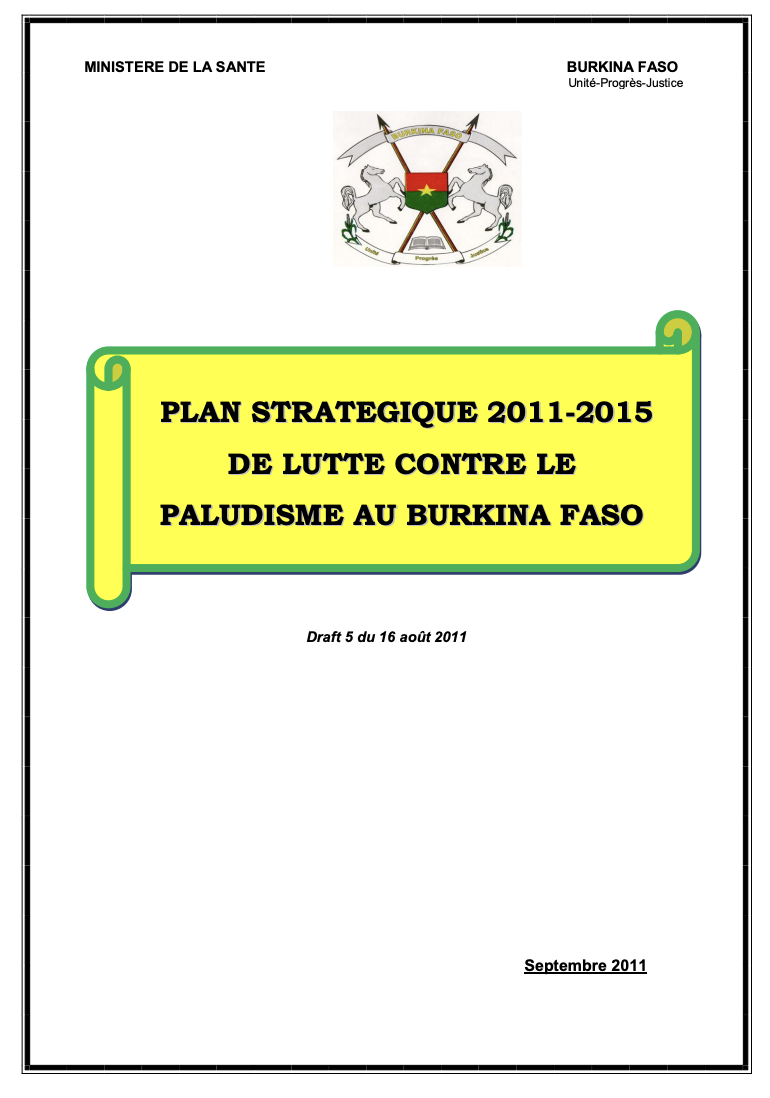
National Malaria Strategic Plan (NMSP) of Burkina Faso: 2011 – 2015
Countries: Burkina Faso
Published: 16/08/2011
Note: A more recent NMSP is available. View it here (link).
The Plan Stratégique National de Lutte contre le Paludisme (PSNLP) 2011-2015 au Burkina Faso serves as a unifying framework for mobilizing all resources. It aims to achieve national and international malaria control objectives by 2015.
Goal: The overall goal is to reduce malaria morbidity by 75% compared to 2000 levels and to bring malaria mortality close to zero in Burkina Faso by the end of 2015.
Specific objectives: To achieve this goal, the following have been adopted:-
- By the end of 2015, 100% of suspected malaria cases are confirmed and treated with appropriate antimalarials in all public, private, and community health facilities;
- By the end of 2015, 100% of pregnant women and children aged 3–59 months will have received malaria chemoprophylaxis;
- By the end of 2015, 100% of the population sleeps under long-lasting insecticidal nets (LLINs);
- By the end of 2015, 100% of the population in targeted high-transmission areas benefits from indoor residual spraying (IRS) in the South-West, Cascades, Hauts-Bassins, and Boucle du Mouhoun health regions;
- By the end of 2015, 100% of larval breeding sites in targeted areas are covered by anti-larval treatment (ALT) in the Centre and Hauts-Bassins health regions;
- By 2015, 100% availability of all quality supplies is ensured at health facilities and at the community level;
- By the end of 2015, at least 80% of the population will adopt behaviors conducive to malaria control;
- By the end of 2015, 100% of health districts will generate monthly malaria data from all public, private, and community-based facilities;
- By the end of 2015, the capacity of the National Malaria Control Program (PNLP) to manage malaria control efforts—including the coordination of partner interventions—will be strengthened.
Strategic areas: To achieve this, seven strategic areas have been identified in the plan: improving case management; strengthening malaria prevention among pregnant women and children; vector control; enhancing communication; managing the supply of antimalarial drugs; strengthening monitoring, evaluation, and research; and improving program management.
Published: 16/08/2011
Related Resources