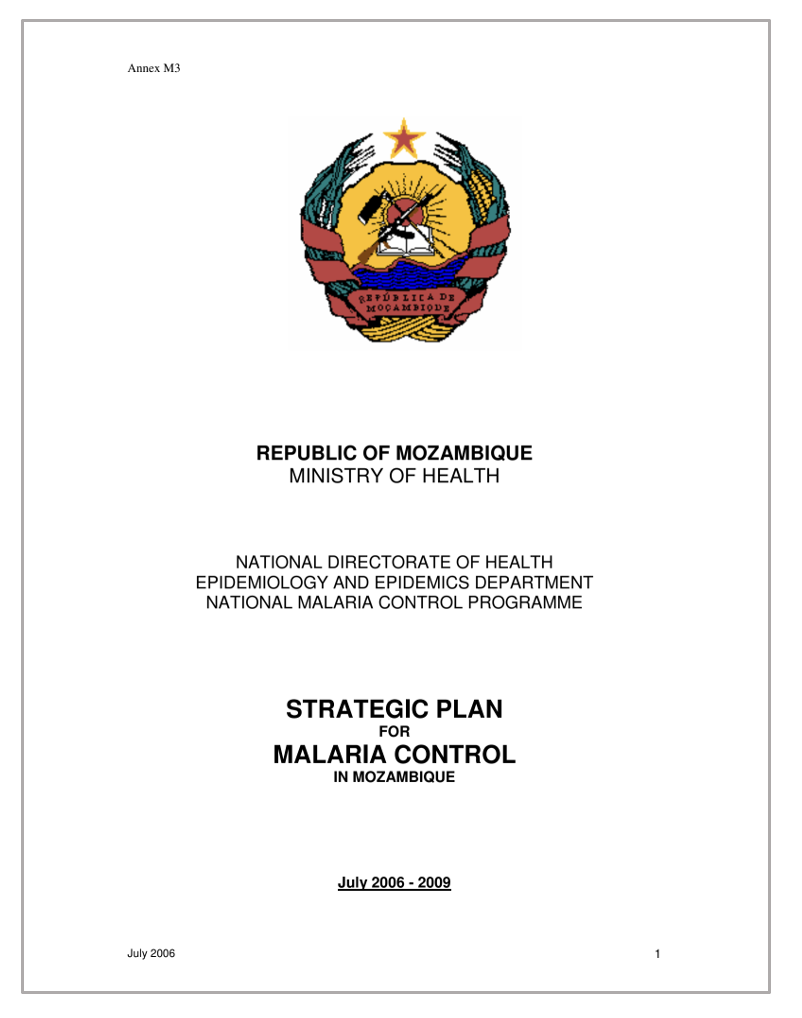
National Malaria Strategic Plan (NMSP) of Mozambique: 2006 – 2009
Countries: Mozambique
Published: 01/07/2006
Note: A more recent NMSP is available. View it here (link).
Objective: To reduce morbidity and mortality due to malaria in the population in general, and in pregnant women and children under five years old and other vulnerable groups, in particular.
Purpose: The purpose of the National Malaria Control Programme is to coordinate and support the delivery of effective interventions for malaria control that will prevent and reduce morbidity and mortality due to malaria.
Global impact goal: To Reduce the malaria burden by half (malaria parasite prevalence and case fatality rate), by 2015 as compared to levels found in 2001 (40% – 80%), thereby achieving the Millennium Development Goal for malaria control (refer
to the Health Sector Policy Statement). In summary:
Specific impact targets:
- Reduction of severe malaria incidence rate in children under five, from 55 per 10.000 found in 2000 to 41 per 10,000 in 2010 and 22.5 per 10,000 in 2015, and attain the Millennium Development Goal,
- Reduction of severe and complicated malaria mortality rate in children under five, from 2 per 10,000 in 2001 to 1.5 per 10,000 in 2010 and 1 per 10,000 in 2015, thereby achieving the Millennium Development Goal,
- Reduction of the proportionate mortality rate due to malaria in children under five, from 30% found in 2001 to 22.5% in 2010, and 15% in 2015,
- Reduction of malaria parasite prevalence rates in pregnant women from 20% in 2001 to 15% in 2010, and 10% in 2015, thereby achieving the Millennium Development Goal,
- Reduction of case fatality and mortality rates due to malaria in pregnant women,
- Reduction of malaria parasite prevalence rates in the two to nine year age group from 60% in 2001 to 45% in 2010, and 30% in 2015, thereby achieving the Millennium Development Goal,
- Reduction of the case fatality rate due to malaria from 7% in 2001 to 5% by 2010, and 3.5 % in 2015, thereby achieving the Millennium Development Goal,
- Improvement in malaria diagnosis quality from the current 25-30% to 60% in 2010, and 80% in 2015.
Published: 01/07/2006
Related Resources