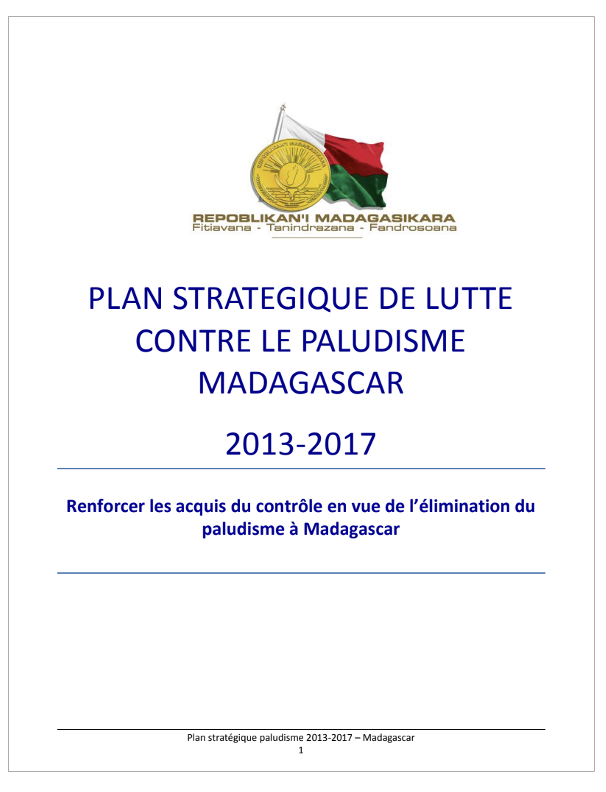
National Malaria Strategic Plan (NMSP) of Madagascar: 2013 – 2017
Countries: Madagascar
Published: 01/12/2012
Note: A more recent NMSP is available. View it here (link).
The interventions outlined in the Plan Stratégique National de Lutte contre le Paludisme (PSNLP) 2013–2017 Madagascar align with the goal of reducing morbidity and mortality and will be implemented based on a new epidemiological profile that divides the country into three operational intervention zones.
Vision: A malaria-free Madagascar. A country that takes ownership of its health.
Goal: Reduce malaria-related deaths to near zero by the end of 2017.
Overall Objective: Reduce malaria-related morbidity to less than 5% in 50% of districts and to less than 10% in the remaining districts by the end of 2017.
Specific Objectives: by the end of 2017:
In pre-elimination districts:
- 95% of structures in targeted zones are sprayed.
- Implement all appropriate surveillance measures in pre-elimination zones.
- Properly manage at least 95% of malaria cases seen at health facilities.
- Properly manage at least 80% of cases involving fever (or reported fever) at the community level within 24 hours of symptom onset in children under five.
- Detect and properly manage 100% of outbreaks.
- Ensure that at least 85% of the target populations in each zone adopt behaviors conducive to malaria control.
- Ensure a constant supply of diagnostic tools and antimalarial treatments in at least 95% of health facilities.
- Ensure quality control for at least 90% of malaria control data reported by health facilities.
In districts in the control phase (scaling up and consolidation):
- Ensure that at least 90% of the population uses ITNs as a prevention measure.
- Ensure that at least 80% of pregnant women adhere to Intermittent Preventive Treatment (IPT) in accordance with the national policy in targeted areas.
- Properly manage at least 95% of malaria cases seen at health facilities.
- Properly manage at least 80% of cases of fever (or reported fever) at the community level within 24 hours of symptom onset in children under 5 years of age.
- Detect and properly manage 100% of emergency situations.
- Ensure that at least 85% of the target populations for interventions in each zone adopt behaviors conducive to malaria control.
- Ensure the constant availability of diagnostic tools and antimalarial treatments in at least 95% of health facilities.
- Ensure quality control for at least 80% of the malaria control data reported by health facilities.
Published: 01/12/2012
Related Resources