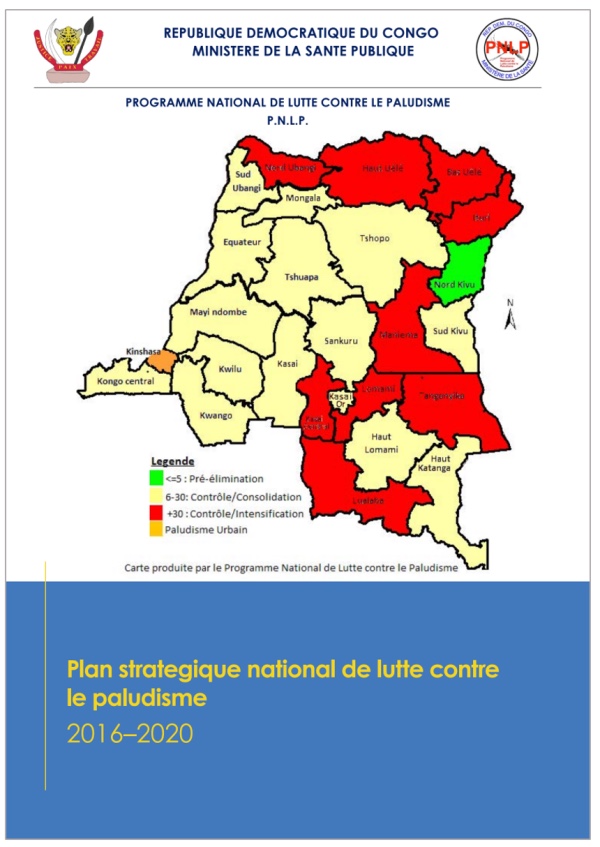
National Malaria Strategic Plan (NMSP) of Democratic Republic of the Congo: 2016 – 2020
Countries: Dem. Rep. of Congo
Published: 04/01/2016
Note: A more recent NMSP is available. View it here (link).
This Democratic Republic of the Congo’s Plan Stratégique National de Lutte contre le Paludisme (PSNLP) 2016–2020 (PSN 2016-2020) is aligned with national and international policy and strategy documents, such as: (i) the National Health Development Plan (PNDS) 2016–2020, for which it operationalizes malaria control efforts in support of the “service delivery” pillar; (ii) the Global Technical Strategy for Malaria 2016–2030; (iii) Action and Investment to Defeat Malaria 2016–2030; and (iv) the African Malaria Strategy (AMS).
Aim: With the aim of contributing to malaria elimination in the Democratic Republic of the Congo, the NSP seeks to improve the population’s health status by reducing the human and socio-economic burden caused by malaria.
Objective: The overall objective of the 2016–2020 NSP is to reduce malaria-related morbidity and mortality rates by 40% compared to 2015 levels.
Strategic objectives:
- protect at least 80% of people at risk of malaria through preventive measures by 2020
- screen at least 80% of fever cases suspected of being malaria and treat 100% of those testing positive in accordance with national guidelines by 2020
- strengthen the surveillance, monitoring, and evaluation system by 2020
- ensure that at least 75% of the at-risk population is knowledgeable about malaria transmission, prevention, and case management by 2020
- strengthen program management by 2020.
Strategies and Activities:
- vector control, including the distribution of long-lasting insecticidal nets (LLINs) through both campaigns and routine delivery, indoor residual spraying (IRS) with residual insecticides, and the promotion of sanitation
- protection of vulnerable groups (pregnant women and children under five) through preventive chemotherapy
- screening of fever cases suspected of being malaria and systematic treatment of all confirmed malaria cases in accordance with national guidelines
- strengthening epidemiological surveillance and monitoring and evaluation
- communication for behavior change
- strengthening program management.
Published: 04/01/2016
Related Resources