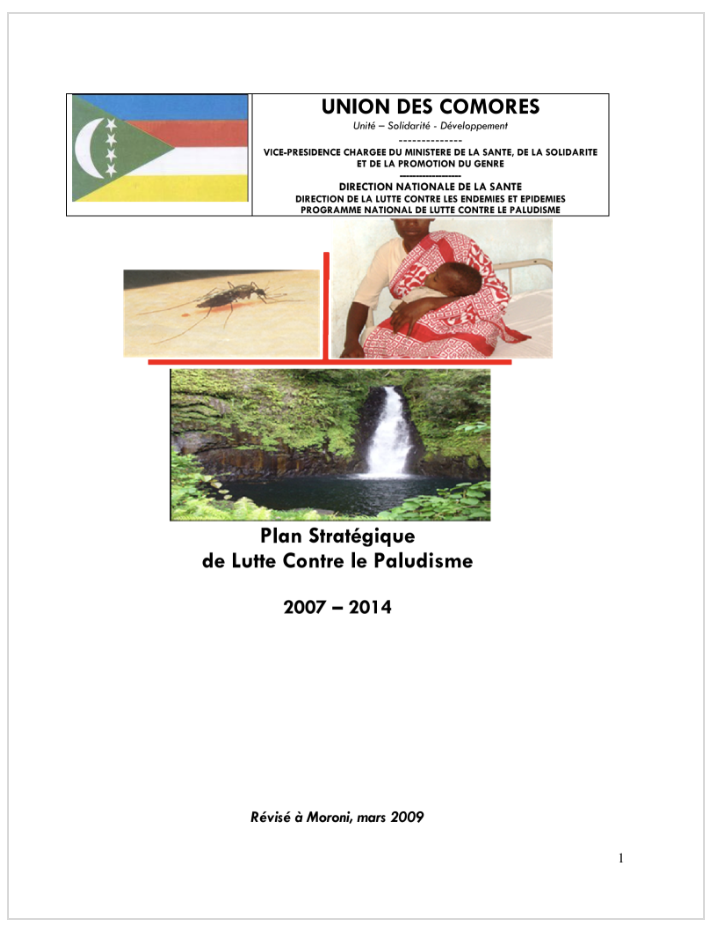
National Malaria Strategic Plan (NMSP) of Comoros: 2007 – 2014
Countries: Comoros
Published: 01/03/2009
The primary objective of the Union of the Comoros National Malaria Strategic Plan 2007 – 2014, called Plan stratégique National de Lutte contre le Paludisme 2007–2014 en Union des Comores, is to interrupt the transmission of the disease through active control of both vectors and parasites. This is to be achieved via a combined approach involving indoor residual spraying (IRS) with insecticides, the large-scale use of long-lasting insecticidal nets (LLINs), intermittent preventive treatment (IPT) for pregnant women, and the diagnosis and mass treatment of malaria using artemisinin-based combination therapies (ACTs).
The achievements of the 2002–2006 strategic plan provide a solid foundation for scaling up malaria control interventions and reducing disease transmission to a level where it no longer constitutes a major public health problem. This represents a new phase in the fight against malaria, one that should lead to the elimination of the disease throughout the entire national territory.
Vision: The vision of the malaria control program in the Union of the Comoros is to eliminate malaria—as a leading cause of morbidity and mortality and an obstacle to economic growth and social development—by 2020, in line with the Millennium Development Goals.
Mission: The mission of the national malaria control program is to contribute, in collaboration with all stakeholders at every level, to improving the health of the Comorian population by providing access to the most effective malaria control interventions—interventions that are recognized as successful and are consistent with the international commitments entered into by the Comorian State.
Goal: The goal of the 2007–2014 strategic plan is to interrupt disease transmission, thereby bringing the country to the pre-elimination phase.
General Objective: The general objective of this national strategic plan is to promote, coordinate, and support the delivery of effective interventions to reduce the prevalence of parasite carriers within the population to less than 5 percent.
Published: 01/03/2009
Related Resources