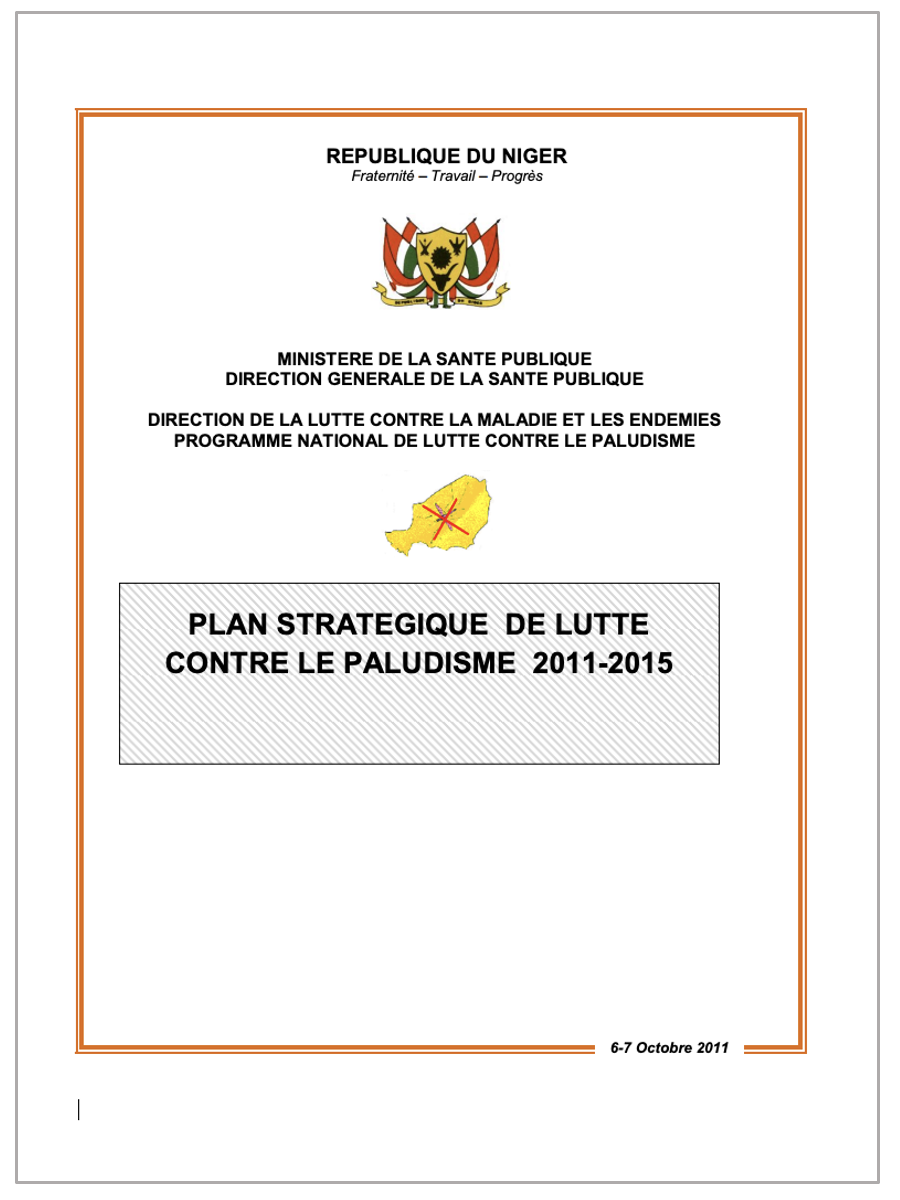
National Malaria Strategic Plan (NMSP) of Niger: 2011 – 2015
Countries: Niger
Published: 06/10/2011
Note: A more recent NMSP is available. View it here (link).
This Plan Stratégique National de Lutte contre le Paludisme (PSNLP) 2011 – 2015, covering the 2011–2015 period, was developed following a review of the National Malaria Control Programme’s (PNLP) performance. The plan aims to achieve universal coverage of essential interventions in order to reduce morbidity and mortality. It also targets the contribution of malaria control efforts to the achievement of Millennium Development Goals (MDGs) 4, 5, and 6 within the context of health system strengthening.
Vision: For a malaria-free Niger
Mission: To ensure universal and equitable access for the population to malaria control interventions, in accordance with the health sector policy and with a view to achieving the Millennium Development Goals (MDGs).
Goal: To contribute to reducing morbidity and mortality in the general population and to ensure that malaria is no longer a public health problem.
Overall objective: To reverse malaria incidence trends by 2015 and begin halting transmission with the aim of eliminating the disease by 2025.
Specific objectives:
- By 2015, ensure biological testing for at least 90% of suspected malaria cases seen in public and private health facilities and in areas with Community Health Workers (CHWs);
- By 2015, ensure appropriate management of at least 90% of uncomplicated or severe malaria cases seen in the public and private sectors, in accordance with national guidelines;
- By 2015, ensure appropriate management of at least 80% of confirmed malaria cases diagnosed biologically in areas with CHWs;
- By 2015, ensure that at least 80% of the population in malaria-risk areas sleeps under long-lasting insecticidal nets (LLINs);
- By 2015, ensure protection with at least two doses of intermittent preventive treatment (IPTp2) for at least 90% of pregnant women;
- By 2015, ensure protection for at least 80% of the population in areas targeted by Indoor Residual Spraying (IRS); – By 2015, ensure that at least 90% of districts under epidemiological surveillance are able to detect and contain potential epidemic situations;
- By 2015, strengthen the management and coordination capacities of the malaria program at all levels.
Published: 06/10/2011
Related Resources