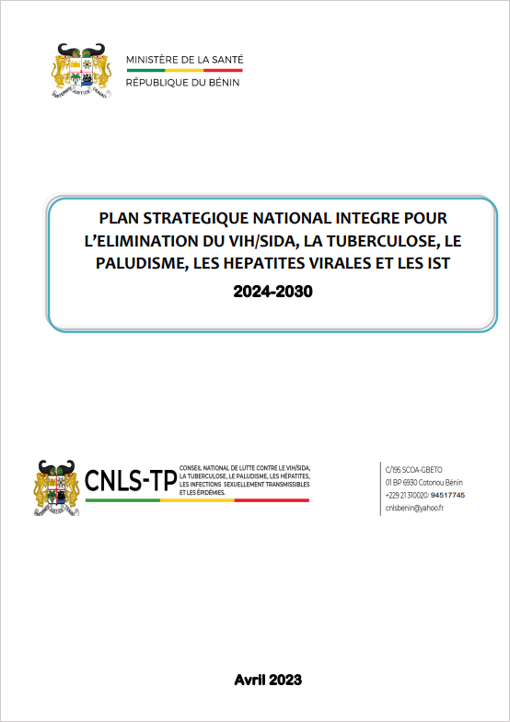
Integrated National Strategic Plan (NSPIE) of Benin: 2024 – 2030
Countries: Benin
Published: 28/04/2023
The Plan Stratégique National Intégré pour l’Elimination du VIH/Sida, du paludisme, de la tuberculose, des hépatites virales, des Infections Sexuellement Transmissibles (IST) et des Epidémies 2024–2030 (PSNIE 2024–2030) incorporates Benin’s malaria strategic framework, equivalent to the National Malaria Strategic Plan (NMSP) (Plan Stratégique National de Lutte contre le Paludisme, PSNLP), outlining the country’s strategic priorities and interventions for malaria control and elimination alongside those for HIV/AIDS, tuberculosis, viral hepatitis, sexually transmitted infections (STIs), and epidemic-prone diseases.
It provides the national framework for coordinating and integrating responses to these priority diseases. Building on a new organizational and programmatic approach introduced in 2020 and led by the National Council for the Fight against HIV/AIDS, Tuberculosis, Malaria, Hepatitis, STIs and Epidemics (CNLS-TP), the plan aims to improve population health—particularly among vulnerable groups—while increasing efficiency through integrated action.
Vision: By 2030, “Benin strengthens its integrated and high-performing governance platform for the national response to priority diseases—one that takes into account gender equality and human rights issues and ensures synergy and effectiveness in the fight against these diseases.”
Overall objective: To contribute to the elimination of HIV, tuberculosis, malaria, hepatitis, STIs, and epidemics by 2030—specifically, by component and based on targets already achieved—while taking into account gender and human rights issues.
Specific objectives:
- eliminate (reduce by 100%) current disparities in new infections associated with the target diseases by 2030;
- eliminate (reduce by 100%) current disparities in mortality and morbidity associated with the target diseases by 2030;
- strengthen integrated governance of the national response to the target diseases;
- reduce human rights and gender-related barriers hindering access by key and vulnerable populations to prevention and care services for the target diseases.
Published: 28/04/2023
Related Resources