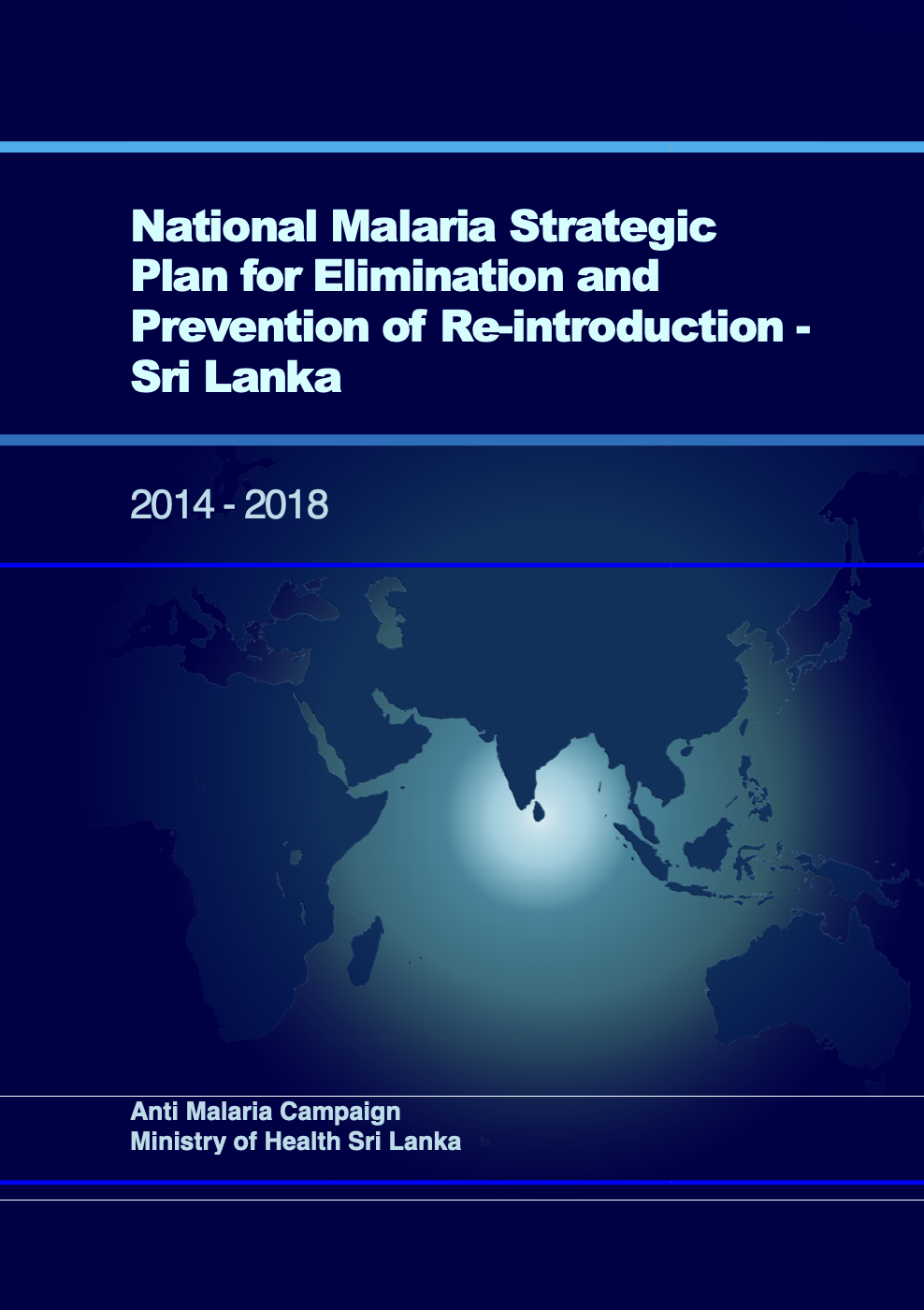
National Malaria Strategic Plan (NMSP) of Sri Lanka: 2014 – 2018
Countries: Sri Lanka
Published: 01/01/2014
Note: A more recent NMSP is available. View it here (link).
The National Malaria Strategic Plan (NMSP) for elimination and prevention of re-introduction 2014-2018 is primarily targeted to achieving and sustaining a malaria free Sri Lanka. Considerable progress has been made against malaria since the beginning of the century with drastic decreases in cases and no indigenous case of malaria being reported since October 2012. This NMSP presents a roadmap to prevent re-introduction of malaria in Sri Lanka focusing on intensified surveillance and response, outbreak preparedness, prevention, early diagnosis and treatment with radical cure. It builds on the achievements of the previous strategic plan and is aimed at achieving World Health Organization (WHO) certification of a “malaria free Sri Lanka”.
Strategic approaches: The National Malaria Strategy provides four strategic approaches that will:-
- guarantee all people have access to early case detection through reliable and accurate diagnostic services and prompt and effective treatment through strengthening of surveillance for malaria case detection;
- guarantee that health care staff are competent and maintain skills to detect malaria cases early and to provide effective treatment to prevent deaths due to malaria;
- improve systems for outbreak forecasting, preparedness, prevention and response; and
- ensure the use of other appropriate and selective vector control methods with the aim of reducing local vector populations by strengthening of entomological surveillance and response through integrated vector control.
Cross-cutting strategies:– In addition to the 4 thrust strategies above, the following five cross-cutting strategies are proposed:
- establishing a rigorous quality assurance programme for malaria elimination to ensure that cases are not being missed and interventions are carried out according to plan with a view to ensure that malaria is not re-introduced in to the country;
- strengthening information, education and communication activities so as to strengthen intersectoral collaboration for malaria elimination and to strengthen the knowledge within communities;
- improving programme management and performance to build capacity to ensure prevention of re-introduction of malaria in the country;
- engaging in operational and implementation research so as to provide evidence based guidance for future modifications of malaria elimination policies/strategies; and
- monitoring and evaluation to ensure optimal programme implementation, management and performance which is a key element in obtaining performance based funding.
Published: 01/01/2014
Related Resources