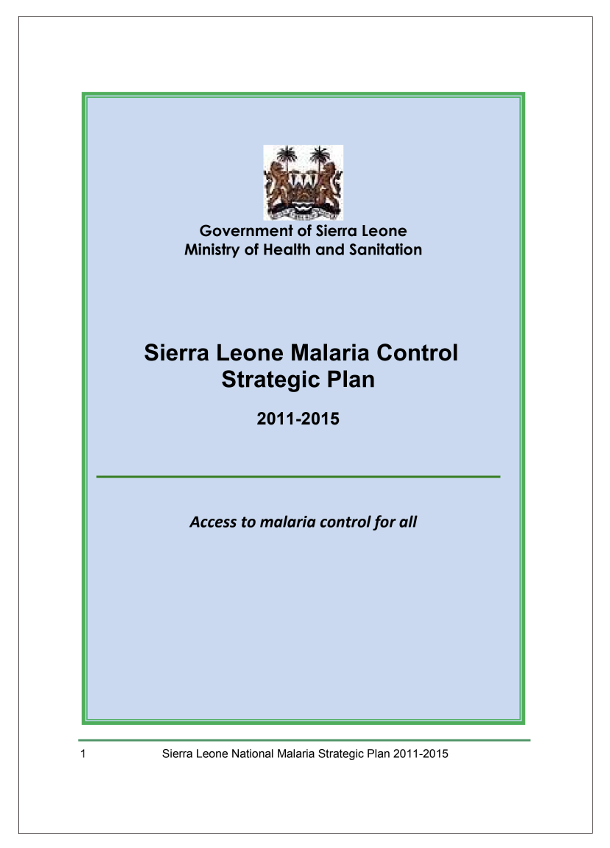
National Malaria Strategic Plan (NMSP) of Sierra Leone: 2011 – 2015
Countries: Sierra Leone
Published: 01/01/2011
Note: A more recent NMSP is available. View it here (link).
It is envisage that the implementation of this National Malaria Control Strategic Plan (NMCSP) 2011–2015 will guide the direction of malaria control activities in the country which will lead to the attainment of the goals and objectives as spelt out in the national strategic plan and the Millennium Development Goals.
Vision: “Access to malaria control for all”
The Government of Sierra Leone believes that every person has the right to access highly effective malaria curative and preventative services delivered as close to the home as possible. Malaria causes enormous suffering to a large proportion of the population each year and considerably hampers the economic growth of the country.
Goals: The Malaria control programme in Sierra Leone aims to improve the health of its people, and thereby their quality of life, by reducing the malaria burden in the country. This goal will be achieved through scaling up access to evidence based malaria control interventions to the entire population.
General Objective: To reduce the current levels of malaria morbidity by 50% and to reduce mortality by 25% by 2015.
Aim: The aim of the National Malaria Control Programme is to:
- Promote, co-ordinate and support the delivery of effective malaria control interventions that will prevent and reduce morbidity, mortality and disability due to malaria and its socio- economic consequences;
- Use new technologies available to produce results and implement improved diagnosis and ensure rapid and prompt treatment for malaria and establish selective malaria vector control activities;
- Develop decentralized multi-sectorial harmonious partnerships in malaria control activities in Sierra Leone from national up to community level.
Specific Objectives:
- To increase prompt and effective treatment of malaria from 50% in 2010 to 80% for all age groups by 2015.
- To reduce the proportion of severe malaria cases by 50% by 2015.
- To Increase access to the uptake of at least two doses of Intermittent Preventive Treatment (IPTp) among pregnant women at health facility and community levels from 72.3% to 90% by 2015.
- To increase the percentage of people having access to at least one prevention method such as LLINs, IRS and or other methods from 25.9% to 80% by end of 2015.
- Increase the utilization of at least one prevention method, Long Lasting Insecticide Treated Nets (LLINs), IRS and/or other appropriate methods among the entire population to 80% by 2015.
- To increase the knowledge, attitude and skills of the general population towards the use of preventive and control measures against malaria from the current levels to 80% by 2015.
- To strengthen management and implementation capacity of the National Malaria Control Programme through effective coordination of partners.
- To strengthen surveillance, monitoring, evaluation and operational research for effective programme management.
Published: 01/01/2011
Related Resources