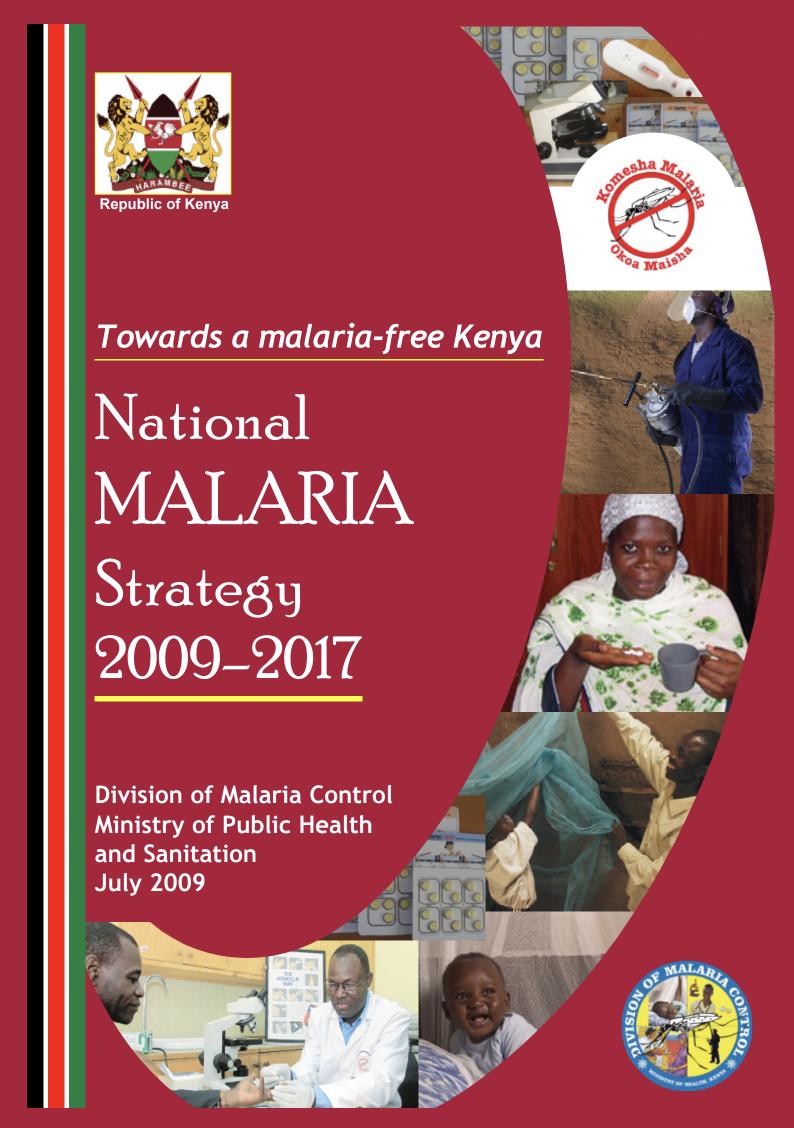
National Malaria Strategic Plan (NMSP) of Kenya: 2009 – 2017
Source(s):
Countries: Kenya
Published: 06/07/2009
Note: A more recent NMSP is available. View it here (link).
The National Malaria Strategy (NMS) 2009–2017 has been developed through a multi-stakeholder, multisector participatory approach in line with recommendations from the Malaria Programme Performance Review (MPR) conducted from March to June 2009. The MPR highlighted programmatic strengths, weaknesses and gaps to address.
Strategic Objectives: The NMS 2009–2017 details the key strategic objectives and targets that the programme should achieve during the implementation period. These are:
- Objective 1: To have at least 80 per cent of people living in malaria risk areas using appropriate malaria preventive interventions by 2013 through:
• Universal LLIN coverage for populations at risk;
• Indoor residual spraying in targeted areas for disease burden reduction; and
• Prevention of malaria in pregnancy. - Objective 2: To have 80 per cent of all self-managed fever cases receive prompt and effective treatment and 100 per cent of all fever cases who present to health facilities receive parasitological diagnosis and effective treatment by 2013 by:
• Strengthening capacity for malaria diagnosis and treatment;
• Increasing access to affordable malaria medicines through the private sector; and
• Strengthening home management of malaria. - Objective 3: To ensure that all malaria epidemic prone districts have the capacity to detect and the preparedness to respond to malaria epidemics annually by 2010 through capacity strengthening for epidemic preparedness and response.
- Objective 4: To strengthen surveillance, monitoring and evaluation systems so that key malaria indicators are routinely monitored and evaluated in all malarious districts by 2011 through capacity strengthening for malaria surveillance, routine monitoring and operational research.
- Objective 5: To strengthen advocacy, communication and social mobilization capacities for malaria control to ensure that at least 80 per cent of people in malarious areas have knowledge on prevention and treatment of malaria by 2014 through the development of appropriate advocacy for uptake of specific malaria interventions.
- Objective 6: To strengthen capacity in programme management in order to achieve malaria programmatic objectives at all levels of the health care system by 2014 through capacity building for human resource and infrastructure and instituting activity performance monitoring.
Language
English
External reference
Published: 06/07/2009
Language
English
Related Resources