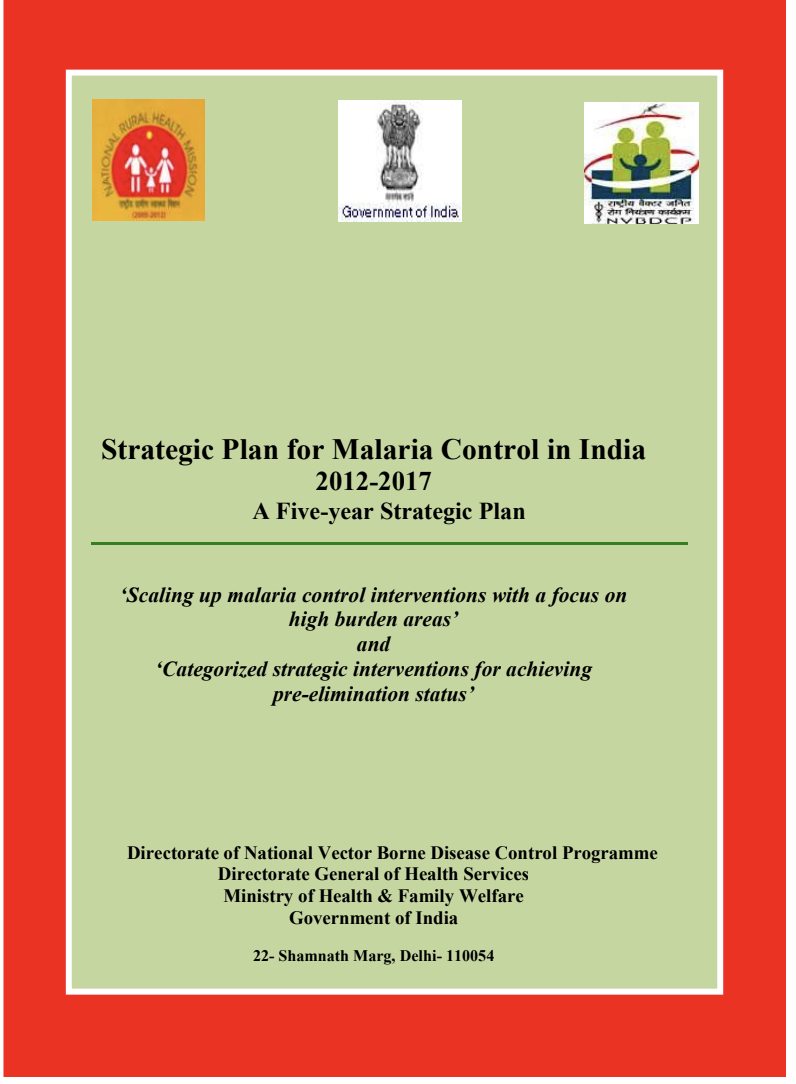
National Malaria Strategic Plan (NMSP) of India: 2012 – 2017
Countries: India
Published: 02/01/2012
Note: A more recent NMSP is available. View it here (link).
This Strategic Plan for Malaria Control in India 2012-2017 is intended to convey how the Ministry of Health and Family Welfare plans to reduce the malaria burden over the 12th five year plan period (2012-17). It focuses on the urgently needed intensified public health action in those areas where the disease remains a major cause of morbidity and mortality in the diverse ecological and epidemiological contexts encountered in India. Considering the wide range of incidence in different districts, the strategy is different for different levels of incidence. Thus, it also considers the interventions in low endemic areas to prevent malaria upsurges. It includes estimates of the human resources, financing, infrastructure and major commodities required for malaria case management and vector control in the whole country.
Vision: The country has a document ‘The Vision 2002’ which emphasizes the expectations from the health care delivery system for malaria by 2025.
Mission: To reduce the morbidity and mortality due to malaria and improving the quality of life, thereby contributing to health and alleviation of poverty in the country
Goals:
- Screening all fever cases suspected for malaria (60% through quality microscopy and 40% by Rapid Diagnostic Test)
- Treating all P. falciparum cases with full course of effective ACT and primaquine and all P. vivax cases with 3 days chloroquine and 14 days primaquine
- Equipping all health Institutions ( PHC level and above), especially in high-risk areas, with microscopy facility and RDT for emergency use and injectable artemisinin derivatives
- Strengthening all district and sub-district hospitals in malaria endemic areas as per IPHS with facilities for management of severe malaria cases.
Objective: To achieve by the end of 2017, API < 1 per 1000 Population
Impact Indicators:
- To bring down annual incidence of malaria to less than 1 per 1000 population at national level by 2017.
- At least 50% reduction in mortality due to malaria by the year 2017, taking 2010 level as baseline
Strategies: India’s National Malaria Strategic Plan (2012-17) is in line with the following broad strategies of the Regional Malaria Strategy of WHO/SEARO.
- Reform approaches to programme planning and management
- Improve and enhance surveillance and strengthen monitoring and evaluation
- Scale up coverage and proper use of insecticide treated bed nets
- Target interventions to risk groups
- Scale up control of P. vivax
Published: 02/01/2012
Related Resources