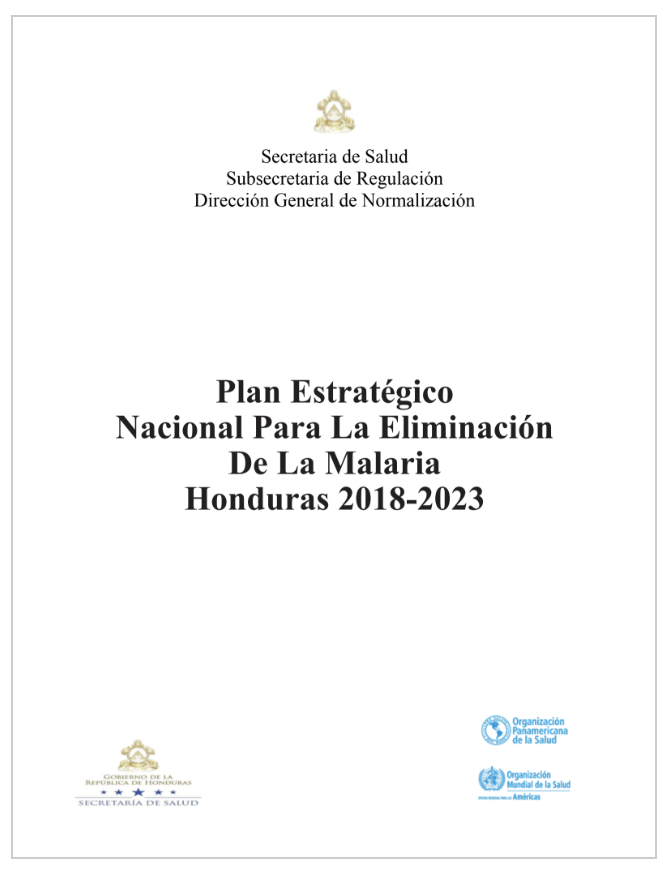
National Malaria Strategic Plan (NMSP) of Honduras: 2018 – 2023
Countries: Honduras
Published: 01/11/2017
The implementation of this National Strategic Plan for Malaria Elimination 2018–2023 called Plan Estratégico Nacional Para La Eliminación de la Malaria Honduras 2018-2023 (PEN-Malaria) will improve the coverage and quality of surveillance, prevention, and control interventions in active foci, while also further reducing malaria transmission in residual foci, in order to achieve the elimination goal set out in the Initiative for the Elimination of Malaria in Mesoamerica and Hispaniola-2020 (Iniciativa de Eliminación de Malaria de Mesoamérica y la Isla Española – EMMIE-2020).
Mission: To ensure epidemiological surveillance processes for the elimination of malaria by 2020, through comprehensive actions and by focusing on epidemiological scenarios differentiated by strata. This includes commitments to strengthen institutional capacity at the local level—as well as community capacity—to monitor and assess risks for outbreak control. Through an integrated approach and strategic alliances with organized civil society, municipal governments, and neighboring countries, these processes must provide reliable data to inform the information system and facilitate better decision-making.
Vision: Honduras achieves the elimination of indigenous *P. falciparum* malaria by 2019 and becomes a country with zero malaria cases by 2020.
Goal: Zero indigenous malaria cases by 2020.
Objectives:
- Strengthen the epidemiological surveillance strategy for malaria, differentiated by strata, while maintaining control over the emergence of outbreaks and utilizing a robust malaria information system.
- Promote Integrated Vector Management (IVM).
- Strengthen the coverage and quality of diagnostic and treatment services to contribute to the malaria elimination strategy.
- Strengthening the role of the health system, including the community component
Published: 01/11/2017
Related Resources