Last Updated: 16/09/2026
Exemplars in malaria subnational tailoring study
Objectives
The goal of the Exemplars in Malaria Sub National Tailoring (SNT) study is to examine both facilitators and barriers to planning, implementing, and sustaining the SNT of malaria interventions.
Specific Objectives:
- Investigate the processes that each study country undertook to operationalize SNT to inform their malaria control strategy and resource allocation and the barriers and facilitators to implementation.
- Frame which best practices, contextual factors, and core capacities enable each step of SNT to be successfully operationalized across study countries.
- Investigate the key decisions that were made because of the SNT as positive/negative deviance from business as usual, the level of implementation of these decisions, and their impact nationally or subnationally.
The work is being done in high malaria burden countries who are positive outliers in the application of evidence-informed subnational tailoring of malaria interventions (SNT) for the development of their national malaria strategic plans and for prioritization of domestic and donor funding for impact. The conceptual framework below was designed in partnership with the Harvard T.H. Chan School of Public Health and the Applied Health Analytics for Delivery and Innovation (AHADI) initiative. The framework maps the stages of the SNT process and identifies several dynamics influencing its implementation. It also distinguishes between contextual factors—the broader environmental, economic, social, and health system conditions that shape the malaria context and are not easily modifiable in the short term—and enablers, which are elements that when strengthened can enhance the implementation of SNT. Although the framework draws primarily from experiences in high-burden settings, it has been adapted to reflect the unique epidemiological, programmatic, and policy contexts of each country. For example, in elimination settings such as the Lao PDR, the framework has been customized to account for lower transmission intensity, evolving surveillance needs, and different stakeholder dynamics, ensuring that it remains relevant and actionable across diverse public health contexts.
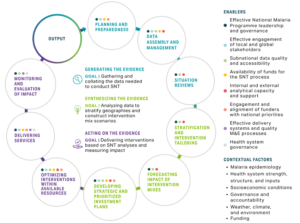
SNT conceptual framework (reference)
Related Resources