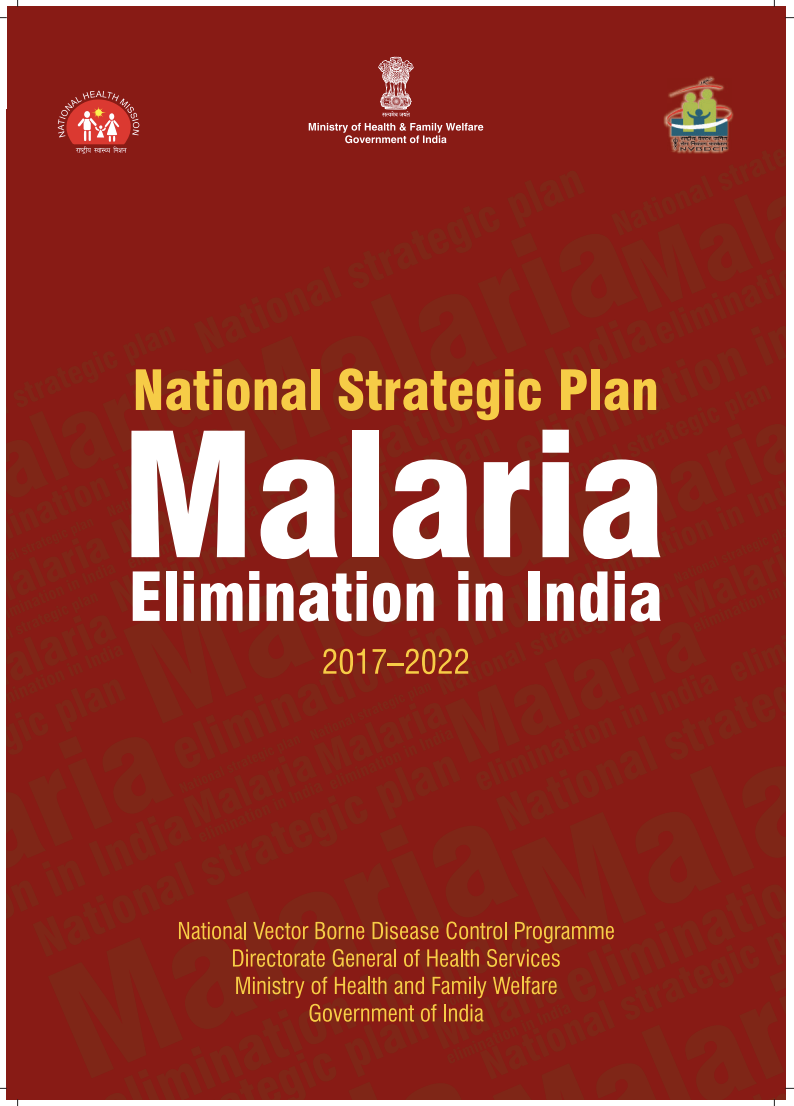
National Malaria Strategic Plan (NMSP) of India: 2017 – 2022
Countries: India
Published: 12/07/2017
Note: A more recent NMSP is available. View it here (link).
The goals of the National Strategic Plan Malaria Elimination in India 2017 – 2022 are phased elimination of malaria in India. The National Framework for Malaria Elimination (NFME) in India has set 2030 as eliminating malaria and goals of NSP are in consonance with overall goals:-
- Eliminate malaria in Category 1 districts (API <1) by 2020 and Category 2 districts (API 1-2) by 2022,
- Reduce transmission in Category 3 districts to stabilize API at <1 by 2022.
Specific objectives of NSP are as follows:
- Achieve universal coverage of case detection and treatment services in endemic districts to ensure 100% parasitological diagnosis of all suspected malaria cases and complete treatment of all confirmed cases.
- Strengthen the surveillance system to detect, notify, investigate, classify and respond to all cases and foci in all districts to move towards malaria elimination.
- Achieve near universal coverage of population at risk of malaria with an appropriate vector control intervention.
- Achieve near universal coverage by appropriate BCC activities to improve knowledge, awareness and responsive behavior regarding effective preventive and curative interventions for malaria elimination.
- Provide effective programme management and coordination at all levels to deliver a combination of targeted interventions for malaria elimination.
In districts where transmission is interrupted, the goal will be to maintain malaria-free status and prevent reintroduction, with particular emphasis on tackling the problem associated with imported malaria. The probability of malaria becoming re-established in a malaria free area varies according to the area’s receptivity and vulnerability. When importation of malaria (e.g. migrant workers from a malaria endemic area) coincides with high receptivity (e.g. halting of anti-malaria measures or of socioeconomic changes) re-establishment of malaria transmission can occur. The following activities will be implemented in such areas:
- Establishing reliable malaria case and entomological surveillance system with full coverage of malaria risk areas.
- Maintain epidemiological and entomological capabilities with an effective operational research component to determine risk and underlying causes of transmission resumption.
- Ensure easy access to reliable laboratory diagnosis and effective and radical treatment for every individual.
- Establish a system for early warning of any impending outbreak/epidemic, preparedness and response.
- Ensure participation of at-risk communities and population groups in malaria prevention activities.
Published: 12/07/2017
Related Resources