Last Updated: 27/02/2026
HAMMS project: Horn of Africa Malaria molecular surveillance
Objectives
To establish a university-malaria program network for surveillance of converging biological threats in the Horn of Africa and demonstrate a model for real-time and granular molecular surveillance to inform policy by identifying locally informative genetic targets and adopting and customizing a highly sensitive, targeted, and multiplexed Plasmodium and Anopheles genotyping toolkit.
Specific objectives:
- Develop and optimize university-based regional coordination, capacity building, and targeted evidence generation and response system.
- Track the flow of malaria parasites/mosquitoes and drug/diagnostic/insecticide resistance within and around Ethiopia.
- Adopt multiplexed microhaplotype based NGS protocol at AHRI.
- Understand the paradox of pfhrp2/3 gene deletion and pfkelch13 R622I co-evolution.
- Pilot cross-border collaboration with Sudan and Djibouti.
- Customize the multiplexed NGS panel with locally informative genetic targets that include regions of selection to study malaria transmission dynamics in Ethiopia in the era of co-emerging biological threats.
Ethiopia National Malaria Elimination Program (NMEP)
Bioscience Research Institute (BRI), Sudan
Association Mutualis, Djibouti
National Malaria Control Program (NMCP) Somalia
National Malaria Control Program (NMCP) South Sudan
University of California San Francisco (UCSF), United States
University of Notre Dame, United States
Barcelona Institute for Global Health (ISGlobal), Spain
The Horn of Africa stands at a critical juncture in malaria control. The region faces interconnected threats that demand immediate, coordinated regional action. All major emerging biological threats have geographically converged in this region:
• Pfhrp2/3 gene deletions (affecting rapid diagnostic tests)
• Antimalarial drug resistance (particularly Pfk13 R622I mutations)
• Insecticide resistance in native and invasive mosquito populations
• Invasive vector species (Anopheles stephensi)
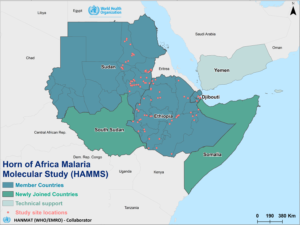
Operating across Ethiopia, Sudan, and Djibouti from November 2023 through October 2026, HAMMS now (January 2026 to December 2028) expands to include South Sudan and Somalia with technical support to be provided to Yemen and collaboration with the Horn of Africa Network for Monitoring Antimalarial Treatment (HANMAT) that is coordinated by the World Health Organization Regional Office for the Eastern Mediterranean (WHO EMRO).
Integrated Surveillance: The next phase will strengthen parasite and vector monitoring
by:
• Tracking pfhrp2/3 gene deletions and drug resistance markers.
• Monitoring the relative contribution to transmission of native and invasive Anopheles species and insecticide resistance.
• Establishing systems to detect genetically modified mosquitoes (considering Djibouti has recently implemented the Friendly mosquitoes).
Capacity Building: HAMMS will invest in training Ministries of Health, public health institutes, and universities across member states for self-reliance. Short courses, postgraduate programs, and hands-on mentorship will ensure sustainability and country ownership.
Data for Action: By 2028, HAMMS will deliver sub-nationally tailored, real-time data integrated into national malaria control programs. Interactive dashboards, predictive models, and risk maps will enable early detection and rapid response to emerging threats.
Regional Collaboration: Through collaboration with HANMAT and WHO regional offices, as well as IGAD, and Africa CDC, HAMMS will align surveillance tools, share data in real time, and support coordinated responses to emerging biological threats. This ensures harmonized surveillance tools, regular data-sharing, and joint regional workshops. Coordinated reporting will strengthen transparency and guide strategic planning.
Capacity Strengthening
Diagnostics
Drug Resistance
Genetics and Genomics
Health Systems
Information Systems
Insecticide Resistance
Surveillance
Nov 2023 — Dec 2028
$4.5M
Related Resources